

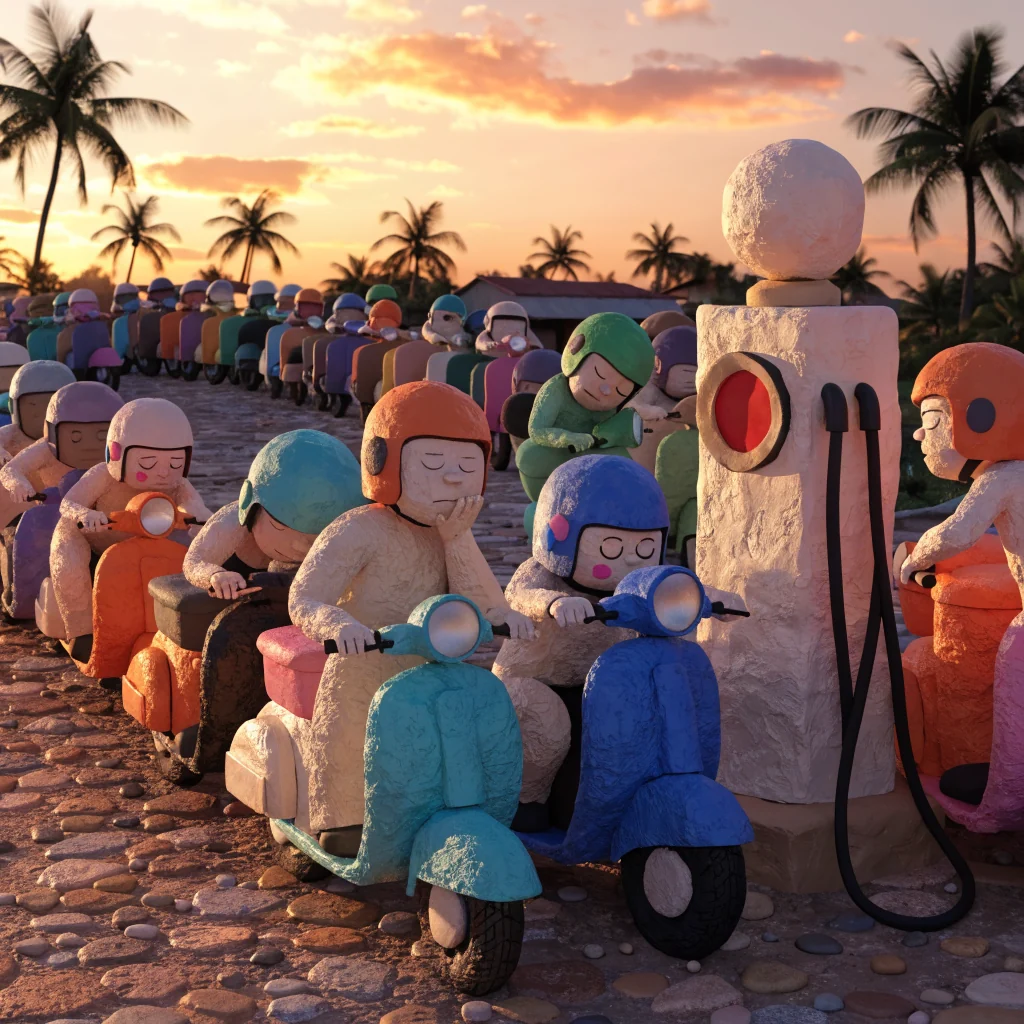
If you live in Bali, you probably spent part of this week doing a brand-new local activity: queueing for petrol. Not for five minutes. For hours. Helmets on, engines off, phones at 12% battery, a long snake of scooters going past the next warung and around the corner.
Since around 11 October 2026, petrol stations across Bali have run dry. Pertalite gone. Pertamax gone. At some stations the only thing left was the expensive Pertamax Turbo, and at others there was simply a sign and an empty pump. TV crews filmed lines of 700 metres, two kilometres, even three kilometres. Some people slept at the station so they would not lose their spot.
So what is going on? Is this just about a late ship? Or is it a small, very visible piece of a much bigger problem that every Indonesian already pays for, every single day, without noticing?
Let’s look at it together. Simply, honestly, and with a little bit of humour, because honestly, what else can you do after three hours in the sun.
The short version (if you are reading this in the queue)
- What happened: tanker ships bringing fuel to Bali were delayed. Stations ran out, people panicked and bought more, and the queues exploded.
- The deeper problem: Indonesia’s fuel system runs on a weak rupiah, imported oil, and a price that is held far below what fuel really costs. It is stretched so thin that one late ship is enough to break it.
- Who pays: not the people who designed the system. You do, in the queue today and in your shrinking savings every year.
- Where Bitcoin fits: Bitcoin will not fill your tank tomorrow. But it was built for exactly this kind of person: someone who works hard and keeps losing to money that others can print.
What it looks like on the ground
Here is the one-minute version from CNA, if you have not seen the queues yourself:
And here is what people told reporters:
- In Tabanan, a resident told Kompas the queues had gone on for about five days, with waits of three to four hours. Now the scooter only comes out for the school pick-up. Everything else waits.
- In Kerobokan, scooter riders were still queueing late into Monday night.
- In Jembrana, 14 stations were affected and people were pushing their motorbikes to the next pump.
- In Karangasem, one rider queued for more than 30 minutes, reached the front, and the stock ran out exactly at their turn. We have all had days like that, but not usually at a petrol station.
- Some stations limited motorbikes to around Rp50,000 per fill-up, according to residents.
- And in Denpasar, shop owners walked along the queue handing out free drinking water. Because that is also Indonesia.

Think about who really feels this. Not the person with a car and a full tank who can work from home. It is the ojek driver who earns nothing while standing in line. The warung owner who cannot get to the market. The delivery rider whose orders get cancelled. The surf teacher, the driver, the cleaner who lose a day of income. Three hours in a queue is three hours of no money.
So why did the pumps run dry?
The official answer is short: distribution. Pertamina said its tankers had technical problems that delayed docking and unloading in Bali. The Energy Ministry says there is enough fuel in the country, with national stock for about 18 to 20 days, and the problem is getting it to the island. Pertamina is sending an extra 26,200 kilolitres in several ships, opened 52 stations around the clock, and President Prabowo called an emergency meeting with Pertamina and the Energy Minister on 14 October.
Here is Pertamina’s explanation in its own words:
That is all true. A ship was late. But it is worth asking one more question, the kind your kid asks when they keep saying “kenapa?”:
Why is the system so fragile that one late ship turns into a three-kilometre queue?
And this is not the first time. Bali had a shortage in November 2025 when bad weather delayed tankers. Bangka Belitung had queues in March 2026. Balikpapan started rationing Pertalite by the hour and Solar by odd and even number plates in September 2026. In 2025, private stations like Shell and BP ran out of petrol for weeks because their import quotas were used up. Different places, different excuses, same picture: long lines of normal people.
The real problem: fuel is paid for in dollars, but you are paid in rupiah
Here is the part nobody puts on the sign at the pump. Indonesia does not produce enough fuel for itself. A big share of what goes into your tank is bought from abroad, and oil is bought and sold in US dollars.
Now look at what has happened to the rupiah against the dollar:
This year the rupiah even touched a record low of nearly Rp18,200 per dollar, while the Indonesian oil price went above $100 a barrel. Weak rupiah plus expensive oil means every litre costs Indonesia much more to bring in.
But the price of Pertalite at the pump has stayed at Rp10,000 per litre. Analysts estimate the real cost is about Rp12,500 to Rp13,500. Someone has to pay that gap, litre by litre, millions of litres a day. The government pays it to Pertamina as “subsidy and compensation”: Rp51.5 trillion in just the first two months of 2026, and over Rp200 trillion by May. If oil stays around $100, the Energy Minister estimated the bill grows by another Rp230 trillion this year.
When the money gets tight, something has to give. Sometimes the price jumps: Pertamax went up about 32% overnight in June 2026. Sometimes there are quotas, QR codes, Rp50,000 limits, and “come back tomorrow”. Sometimes the system has no spare room at all, so when a ship is late, there is no buffer. And then everybody panic-buys, which makes it worse.
How one late ship becomes your three-hour afternoon
- The rupiah keeps getting weaker. More rupiah are created every year, so each one is worth less, including against the dollar.
- Imported fuel gets more expensive in rupiah. The oil did not change. Your money did.
- The pump price is held down by subsidy. That is politically popular, but the gap grows every year and has to be paid from somewhere.
- The system runs with no spare room. Quotas, tight budgets and limited stock mean there is no cushion when something goes wrong.
- A ship is late, people panic, the pumps go dry. The weakest link breaks first.
- You stand in the queue. And you also pay for the subsidy later, through taxes, government debt, and prices that keep going up.
Who always pays? The normal person
Here is the uncomfortable truth: when money breaks, it never breaks evenly.
People with power and big balance sheets usually see the problem coming. They hold dollars, property, or assets abroad. They have generators, full tanks, and drivers who queue for them. Normal people hold rupiah, in a savings account or under the mattress, and they find out last. Indonesia has seen this film many times:
1998
The rupiah crashed from around Rp2,400 per dollar to over Rp16,000 at its worst. Prices rose 58% in one year. In May 1998 fuel prices were raised sharply, and the anger spilled into the streets. Millions of families lost their savings.
2005
Fuel prices were raised twice in one year as oil got expensive. In October, petrol nearly doubled overnight.
2013 to 2015
The rupiah slid from about Rp9,700 to over Rp13,000 per dollar, and fuel prices went up again and again.
2022
Pertalite jumped from Rp7,650 to Rp10,000 per litre in one day.
2026
The rupiah passes Rp18,000 per dollar, Pertamax rises 32% in June, and in October Bali runs out of petrol.
The pattern is always the same. The system creates more money to get out of trouble, the money loses value, prices go up, and the person with the least power pays the most. Not with a big dramatic bill, but quietly: a smaller plate of nasi goreng, a tank that costs more to fill, savings that buy less every year.
Look at the pump itself. With the same Rp100,000:
What Rp100,000 buys at the Pertamax pump
About three and a half full scooter tanks in 2010. About one and a half today. Pertamax was Rp6,800 per litre in 2010 and Rp15,950 in 2026, using published Pertamina prices.
And it is not just fuel. If you saved Rp1,000,000 in 2010 and kept it safe, never spending a rupiah, today it buys only about what Rp560,000 bought back then. You did nothing wrong. You were just holding money that someone else can make more of.
Bitcoin was made for exactly this person
On 3 January 2009, in the middle of the global financial crisis, someone called Satoshi Nakamoto launched Bitcoin. Inside the very first block, Satoshi left a newspaper headline from that day:
“The Times 03/Jan/2009 Chancellor on brink of second bailout for banks.”
That was the message. Banks made bad bets, governments rescued them with new money, and normal people paid for it with their jobs, their homes and their savings. Bitcoin was the answer: money that nobody can print more of, that nobody can freeze, and that belongs to the person who holds it. Not to a bank, not to a government, not to a company.
Rupiah (and all printed money)
- More can be printed any time
- Loses value every year, quietly
- Rules decided for you, without you
- Bank can freeze or limit your account
- In a crisis, you find out last
Bitcoin
- Only 21 million, ever. Nobody can add more
- Rules are the same for everyone, open for anyone to check
- Works 24/7, no permission needed
- Held in your own wallet, it is really yours
- No queue, no quota, no “come back tomorrow”
Let’s be honest
Bitcoin does not fix a late tanker. It will not put petrol in your scooter today, and you should never put money you need next month into anything that moves around a lot. Bitcoin’s price goes up and down, sometimes a lot, and it has dropped more than 70% more than once. This article is not investment advice and we are not making any price predictions.
What Bitcoin does is something different: it gives normal people a way to save in money that cannot be printed. So the next time the system needs to rescue itself, the bill does not quietly come out of your savings. Start small, learn first, and hold your own keys.
See it for yourself: play inflasi
Reading numbers is one thing. Feeling them is another. That is why we built inflasi.bitcoinindonesia.xyz, a free little game where you can see with your own eyes what broken money does to your life. No sign-up, no ads, no tracking, and it works in Bahasa Indonesia and English.
Your rupiah makes you poor. Here is the proof.
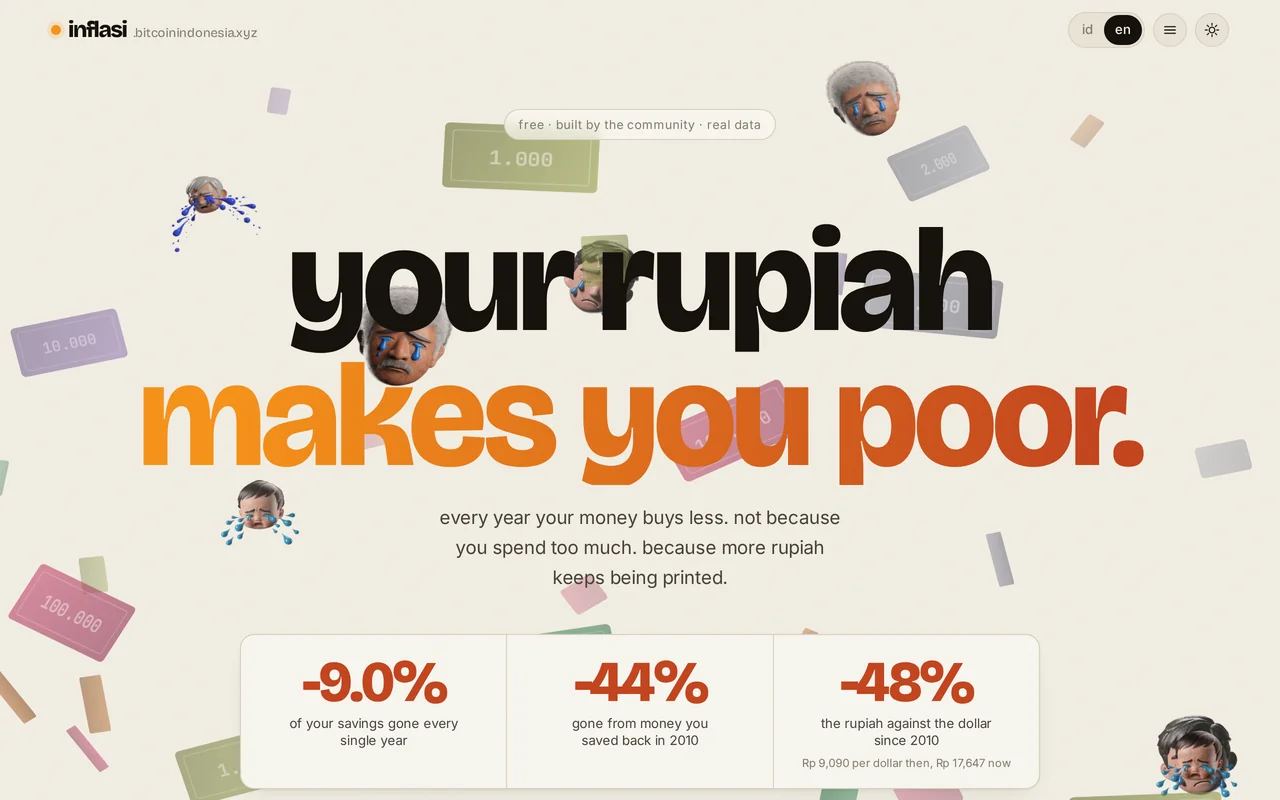
- Warung time machine: slide back to 1998 and watch what Rp50,000 used to buy, including litres of Pertamax.
- Your money melts: type in your savings and see how much disappeared without you spending anything.
- Your salary in a time machine: your pay went up, so why does it feel like less?
- The money factory: press “print more” and see why prices keep going up.
- The savings race: bank, gold, rupiah or Bitcoin. Same monthly amount, real history. Who wins?
What you can do this week
- If you are in Bali: only fill up what you need, check which stations are open 24 hours, and do not panic-buy. Panic is what turns a delay into a disaster. Share your water.
- Play the game and send it to one person you love, especially the one who keeps all their savings in rupiah.
- Learn the basics, slowly and for free, on our education page. Start with What is Bitcoin: The Basics and why money printing leads to inflation.
- Want the full story of the rupiah? Read The Long Struggle: Indonesia’s Money History.
- Come to a meetup. Real people, no sales pitch, and you can ask anything. In Bali? Join the Bitcoin meetups in Bali, or find your city in our community.
The queues in Bali will clear. The ships will dock. But the money problem underneath does not go away when the pumps are full again. The good news: for the first time in history, normal people have a way out that nobody can print, freeze, or ration. You just have to learn how to use it.
Sources: Kompas, Detik Bali, Bali Post, Suara, Tempo, Jakarta Globe, The Star, Katadata, Antara and CNA reporting from 7 to 14 October 2026. Exchange rate, inflation and money supply figures from Bank Indonesia, BPS and the World Bank, as used in inflasi.bitcoinindonesia.xyz. Pertamax prices from published Pertamina announcements. This is education, not financial advice.