

If you are new to Bitcoin in Indonesia, you probably have two questions. Is Bitcoin legal in Indonesia? And will I get in trouble with taxes if I own some?
The short answers are yes, it is legal, and no, you will not get in trouble if you follow the rules. This article explains both answers in plain language, using the current rules as of August 2026.
We are an education non-profit. We do not sell Bitcoin, and nothing here is a suggestion to buy it. We just want you to understand the rules so you can make your own informed decisions.
The short answer, in five points
- Owning, buying, and selling Bitcoin is legal in Indonesia. It is not legal tender.
- Since 10 January 2025, the regulator is OJK, not Bappebti.
- Buying Bitcoin is not a taxable event.
- Selling or swapping is taxed at a final 0.21% on OJK-licensed platforms, or 1% on foreign ones.
- VAT (PPN) on crypto transactions was abolished on 1 August 2025.
Is Bitcoin legal in Indonesia?
Yes. Owning and trading Bitcoin is legal in Indonesia. There is no law that bans individuals from buying, holding, or selling Bitcoin.
But there is an important distinction to understand. Bitcoin is legal, but it is not legal tender. Legal tender means money that a country officially recognizes for paying debts and daily transactions. In Indonesia, the only legal tender is the Rupiah. This is confirmed by Bank Indonesia.
So what is Bitcoin, legally, if it is not money? Under Indonesian law, Bitcoin is classified as an investment asset, similar in spirit to how stocks or bonds are treated. You can own it, trade it, and pass it on. You just cannot force a shop to accept it as payment for goods and services, because it is not currency under Indonesian law.
This classification comes from Law No. 4 of 2023, known as UU P2SK (Undang-Undang Pengembangan dan Penguatan Sektor Keuangan). This law reclassified crypto assets from a commodity into a digital financial asset. That single change is the legal foundation for everything else in this article, including who regulates crypto and how it is taxed.
If you are still working out what Bitcoin actually is before worrying about the paperwork, start with our beginner explainer, Bitcoin Explained Simply.
Who regulates Bitcoin in Indonesia now?
This is the part that confuses a lot of people, including people who wrote articles about crypto in Indonesia a few years ago. The regulator changed.
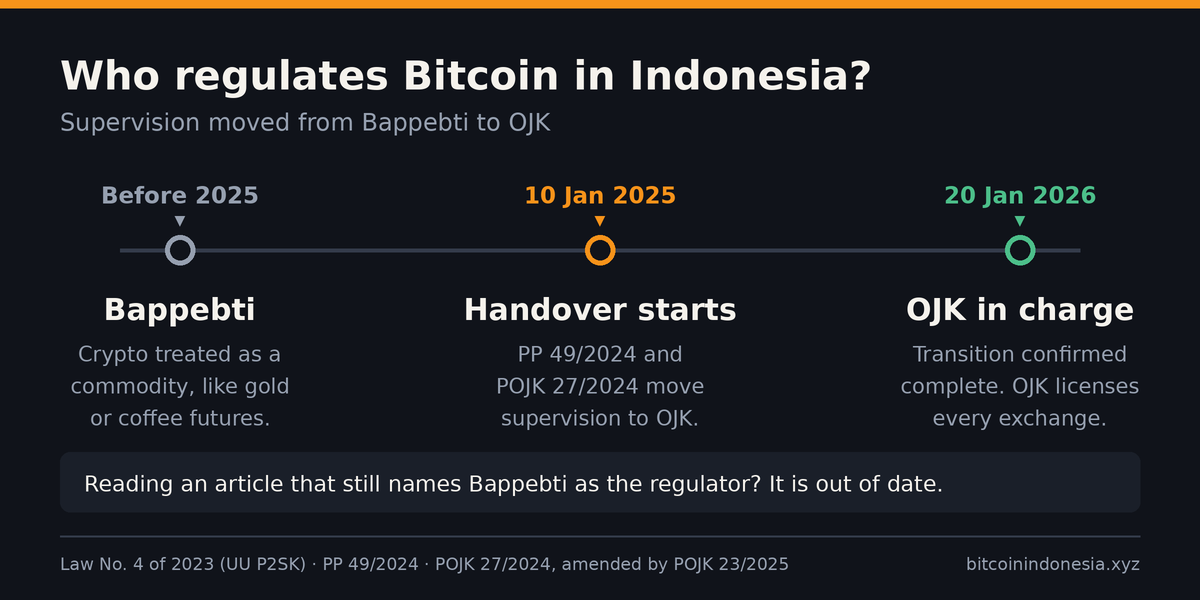
Until early 2025, crypto in Indonesia was supervised by Bappebti, the commodity futures trading regulator. This made sense under the old classification, when crypto was treated as a commodity, similar to gold or coffee futures.
Once UU P2SK reclassified crypto as a digital financial asset, supervision needed to move to the regulator that handles financial assets. That regulator is OJK, the Otoritas Jasa Keuangan, which is Indonesia’s main financial services authority. It also supervises banks, insurance, and the stock market.
The handover happened on 10 January 2025, under Government Regulation PP 49/2024 and OJK Regulation POJK 27/2024, which was later amended by POJK 23/2025. Bappebti and OJK jointly confirmed that the full transition was complete on 20 January 2026.
In plain terms, that means:
- OJK now licenses crypto exchanges and handles day to day supervision.
- Bank Indonesia still has a role, because it oversees the payment system in general.
- Bappebti is no longer the regulator for crypto trading.
If you read an older article that mentions Bappebti as the crypto regulator, that article is describing the rules before January 2025. It is out of date.
What tax do you pay on Bitcoin in Indonesia?
Tax rules changed in 2025 too. The current rules come from PMK 50/2025, a Ministry of Finance regulation signed on 25 July 2025 and effective from 1 August 2025.
Here is the part that surprises most beginners: buying Bitcoin is not a taxable event. You are only taxed when you sell or swap it. Nothing happens, tax-wise, at the moment you buy.
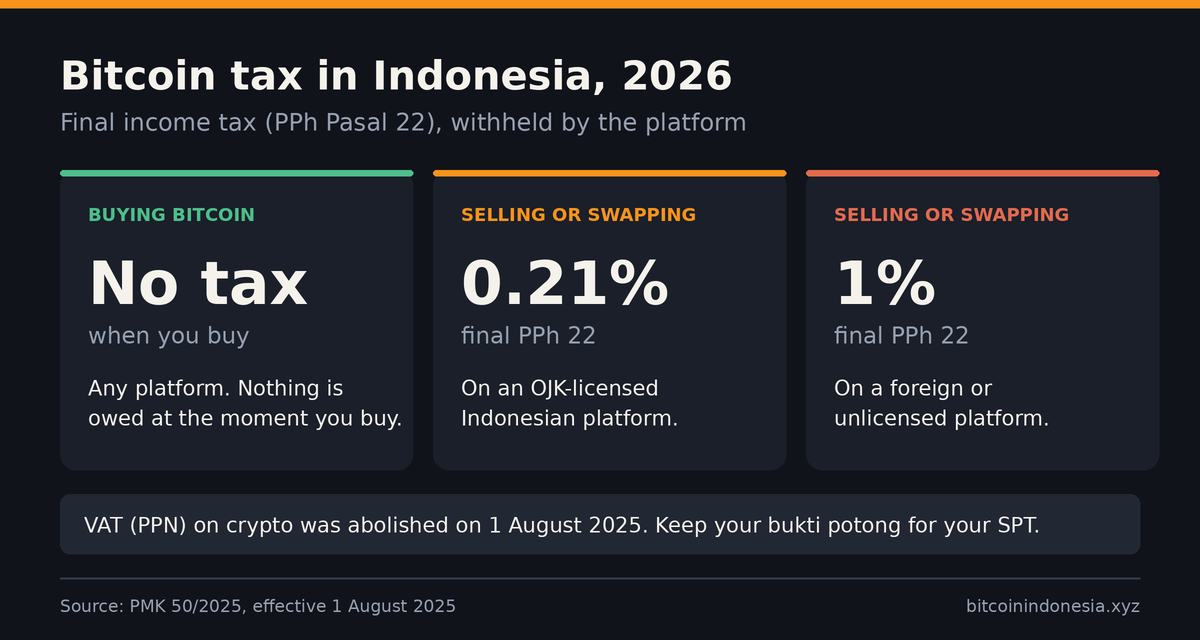
There used to be a VAT (PPN) charge on crypto transfers. As of PMK 50/2025, that VAT has been abolished. Crypto transactions are now taxed more like securities transactions, not like ordinary goods.
What remains is an income tax, called PPh Pasal 22, and it is final, meaning it is settled at the time of the transaction and you do not need to add it to your other income calculations later. The rate depends on where you trade.
| Action | Platform type | Tax you pay |
|---|---|---|
| Buying Bitcoin | Any platform | No tax event |
| Selling or swapping Bitcoin | OJK-licensed Indonesian platform | 0.21% final income tax (PPh 22) |
| Selling or swapping Bitcoin | Foreign, unlicensed platform | 1% final income tax (PPh 22) |
You do not need to calculate this tax yourself. The platform withholds it automatically at the time of the transaction, the same way tax is withheld from a salary before it reaches your bank account.
What you do need to do is keep your bukti potong, which is the official withholding slip the platform gives you. You will need it as supporting evidence when you file your annual SPT (tax return). Think of it as a receipt that proves the tax was already paid.
There is a separate rule for Bitcoin miners. From tax year 2026, the final PPh Pasal 22 rate for miners changes to the general income tax rate instead of a flat final rate. Miners who are registered as PKP (a VAT-registered business) also collect VAT on their verification services, at an effective rate of 2.2%. This applies to mining businesses, not to ordinary individuals who simply buy and hold Bitcoin. If mining is what brought you here, we cover the wider picture in Bitcoin Mining in Indonesia.
What changed in 2025 and 2026, and why old articles get it wrong
If you search online, you will find a mix of old and new information, sometimes on the same website. Here is a quick summary of what changed, so you can tell which articles are current.
Before August 2025, crypto sellers paid two separate charges: an income tax of 0.1% plus an effective VAT of 0.11% on Bappebti-registered platforms, or 0.2% plus 0.22% on other platforms. That system is gone.
Since 1 August 2025, under PMK 50/2025, the VAT is gone entirely, and the income tax is a single final rate, 0.21% on OJK-licensed platforms or 1% on foreign platforms, as shown in the table above.
Since 10 January 2025, OJK is the regulator, not Bappebti. The full handover was confirmed complete on 20 January 2026.
So if an article talks about Bappebti as the regulator, or mentions a 0.1% plus 0.11% tax structure, it was written before these changes and no longer describes current rules.
What about holding your own Bitcoin?
This is a question exchanges rarely explain clearly, because it is not really about trading. It is about self-custody, which means holding your own Bitcoin in a wallet you control, rather than leaving it on an exchange. We explain the trade-offs in detail in Bitcoin Self-Custody vs. Custodial Services.
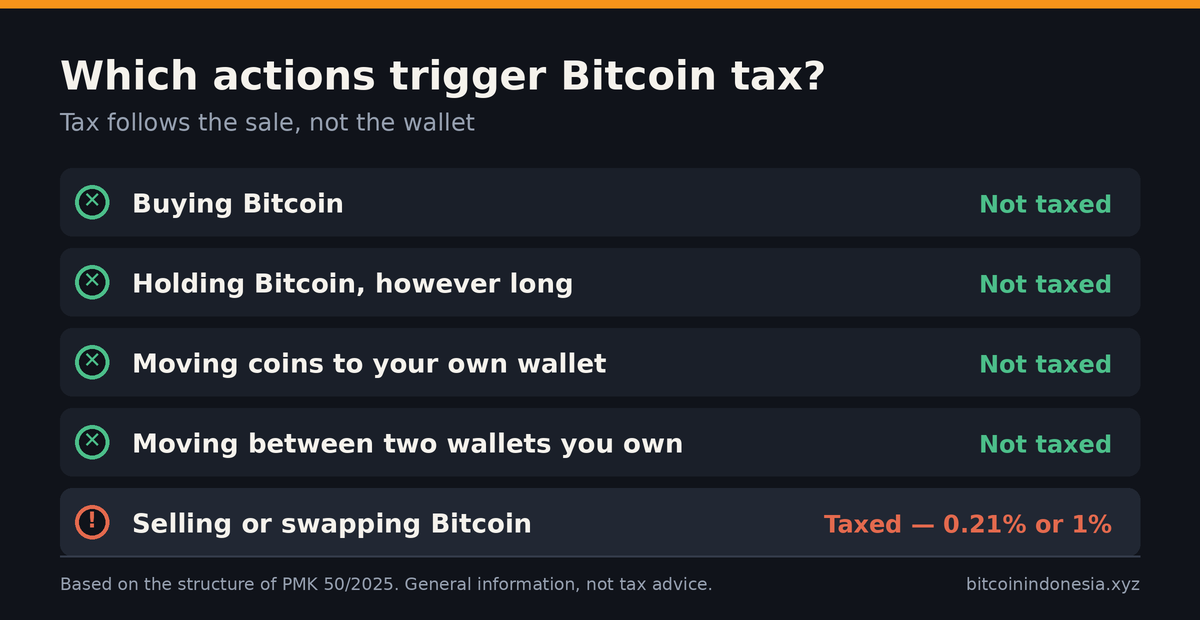
Based on the structure of PMK 50/2025, tax is triggered by selling or swapping. Simply holding Bitcoin is not a sale, so it is not a taxable event by itself. Moving your own Bitcoin from an exchange to your own wallet, or between two wallets you own, is also not a sale. You still own the same asset before and after the move. No income tax withholding applies to that kind of transfer, because there is no buyer, no seller, and no transaction platform collecting a final tax on it.
This matters for beginners because it means learning to use your own wallet is not, in itself, a tax event to worry about. It is a security practice, separate from the question of when tax applies. If you want to learn how that works in practice, read Securing Your Bitcoin: A Guide to Bitcoin Wallets.
We want to be careful here and not overstate this. Tax law can be interpreted differently in specific situations, and your personal circumstances may differ. This is general information about how the tax is structured, not a guarantee about your specific case. If you are unsure, ask a tax professional.
How to check if a platform is actually licensed
Since the tax rate you pay depends on whether a platform is OJK-licensed, it is worth knowing how to check this yourself, rather than trusting a platform’s own marketing.
OJK publishes an official list of licensed crypto asset trading platforms on its website, ojk.go.id. Before using any platform, look for this list and confirm the platform’s exact legal name appears on it. Do not rely on logos, app store badges, or claims made on a platform’s homepage. Check the official source directly.
For an overview of the platforms Indonesians commonly use, see Best Bitcoin Exchanges in Indonesia, and if you have never made a purchase before, How to Buy Bitcoin: A Simple Guide walks through the steps. Always confirm a platform’s current licence status on the OJK list yourself, because licences change.
Frequently asked questions
Is Bitcoin legal tender in Indonesia?
No. Bitcoin is legal to own and trade, but the only legal tender in Indonesia is the Rupiah. A merchant is not obliged to accept Bitcoin as payment.
Do I pay tax when I buy Bitcoin in Indonesia?
No. Buying is not a taxable event under PMK 50/2025. Tax applies when you sell or swap.
How much tax do I pay when I sell Bitcoin?
A final income tax (PPh Pasal 22) of 0.21% on an OJK-licensed Indonesian platform, or 1% on a foreign or unlicensed platform. The platform withholds it for you.
Do I have to report Bitcoin in my annual SPT?
The tax on your sales is final and already withheld, but you should keep your bukti potong from the platform as supporting evidence when you file. A tax professional can confirm what your specific situation requires.
Is it legal to hold Bitcoin in my own wallet in Indonesia?
Yes. Self-custody is legal, and moving coins between wallets you own is not a sale, so it is not a taxable event by itself.
Is Bitcoin mining legal in Indonesia?
Yes, and from tax year 2026 miners are taxed at the general income tax rate rather than a flat final rate. PKP-registered miners also collect VAT on verification services at an effective 2.2%.
A note on this article
This article is educational information only. It is not tax advice and it is not legal advice. Tax and financial regulations in Indonesia can and do change, as this article itself demonstrates. Your personal situation may involve details this general overview does not cover. Please consult a licensed tax professional or legal advisor before making decisions based on your specific circumstances.
For official and up to date information, refer directly to:
- pajak.go.id, the official website of the Indonesian Directorate General of Taxes
- ojk.go.id, the official website of Otoritas Jasa Keuangan
- bi.go.id, the official website of Bank Indonesia
This article was accurate as of August 2026. Rules may have changed since then, so always check the official sources above for the latest information.
Want to learn more?
Understanding the rules is just the first step. If you want to learn more about Bitcoin in a friendly, no-pressure environment, come say hello at a Bitcoin Indonesia meetup, or visit Bitcoin House Bali if you are in the area. No prior knowledge needed, and no one will try to sell you anything. We are here to help you learn.